Piazzetta S. Francesco d’Assisi, 3/a – 25122 Brescia
+39 030 2926701
conventosanfrancescobs@gmail.com
https://www.sanfrancescobrescia.com)
Every day 6:45 AM – 11:30 AM / 3:00 PM – 7:15 PM
During the summer, the church opens in the afternoon at 4:00 PM
The Centuries-Old History of the Complex of St. Francis of Assisi in Brescia
The Church of St. Francis of Assisi and its attached conventual complex represent an invaluable historical-artistic treasure in the heart of Brescia, with roots deeply embedded in the 13th century.
It is said that the Franciscan presence in the city began with the very Poverello of Assisi. Returning from a meeting in Bergamo with St. Dominic, Francis is believed to have stayed for a few days in Brescia, finding hospitality at the Church of St. George. This presence is also confirmed by Thomas of Celano, who, in his biography, mentions the arrival of a friar from Brescia to Siena in 1226, witnessing the swift spread of the order. The arrival of the first friars was actively encouraged by Bishop Alberto da Reggio. Initially settled at St. George, the group later moved to the current location, when the Municipality decided to finance the construction of a new convent.
A crucial moment occurred in 1248. In a period marked by bitter conflicts between the Guelph and Ghibelline factions, the friars distinguished themselves as peacemakers, tirelessly working to restore tranquility to the city. It was the population itself, eager to end the internal rivalries, that made a solemn vow to St. Francis for the construction of a great church in his honor.
Once the long-awaited peace was achieved, the commitment was fulfilled: between 1254 and 1265, the construction of the new temple and the adjacent convent began.
The identity of the main builder is most likely attributed to Marco da Brescia. However, there is an intriguing alternative hypothesis suggesting the influence of Lombard friars, who had been brought to Palermo as prisoners by Emperor Frederick II. This theory is based on the remarkable stylistic similarity between the Brescia church and its namesake church of St. Francis of Assisi in Sicily.
Architecture and Art Treasures of the Church of St. Francis
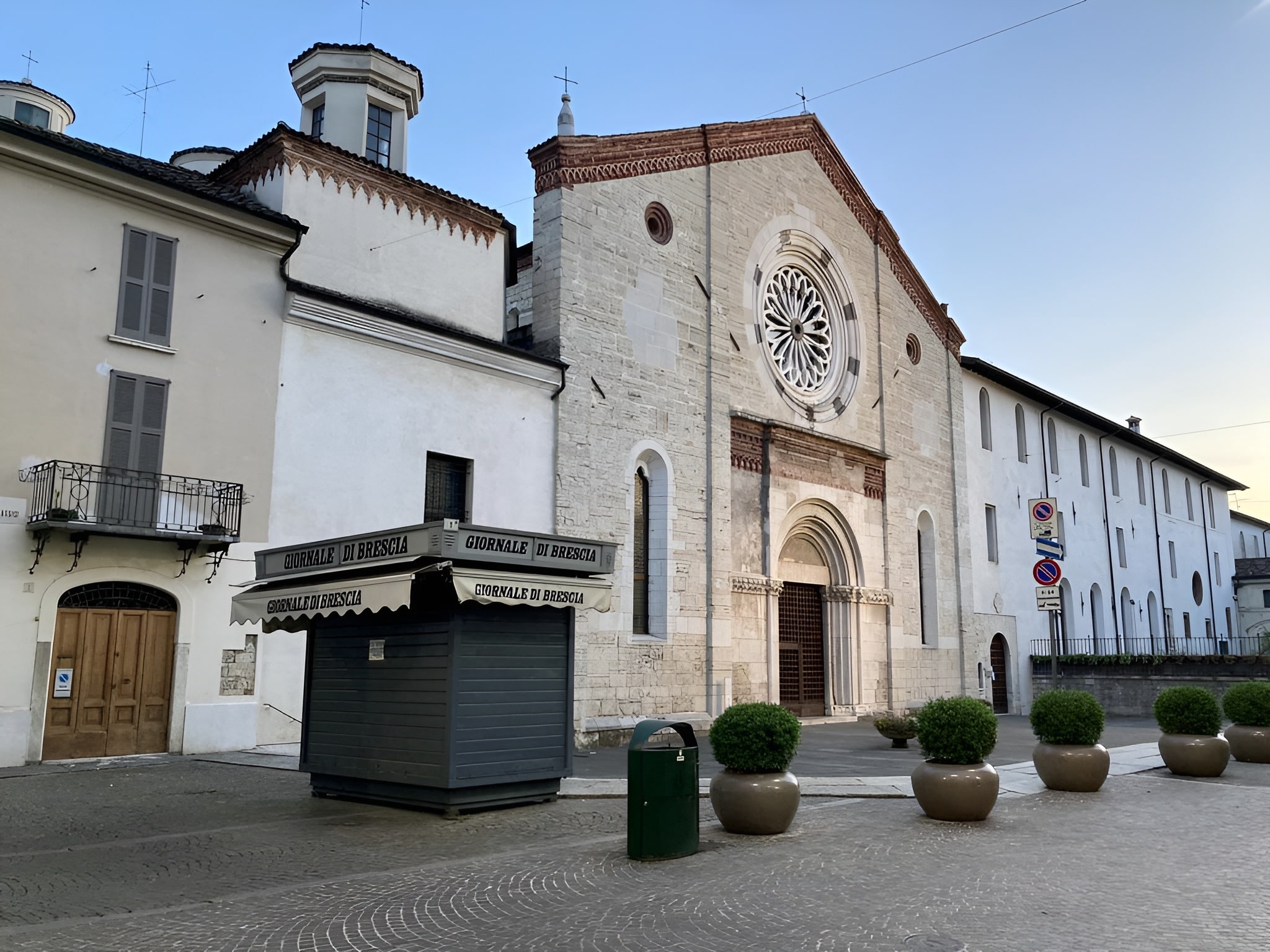
The Church presents itself as a fine example of transitional style between the Romanesque and Gothic. From the initial construction phase, we still have the robust and massive western wall, the imposing belfry, and the facade made of local stone (medolo). The latter stands out for its gable roof, framing a magnificent rose window and an imposing marble portal with chamfered edges.
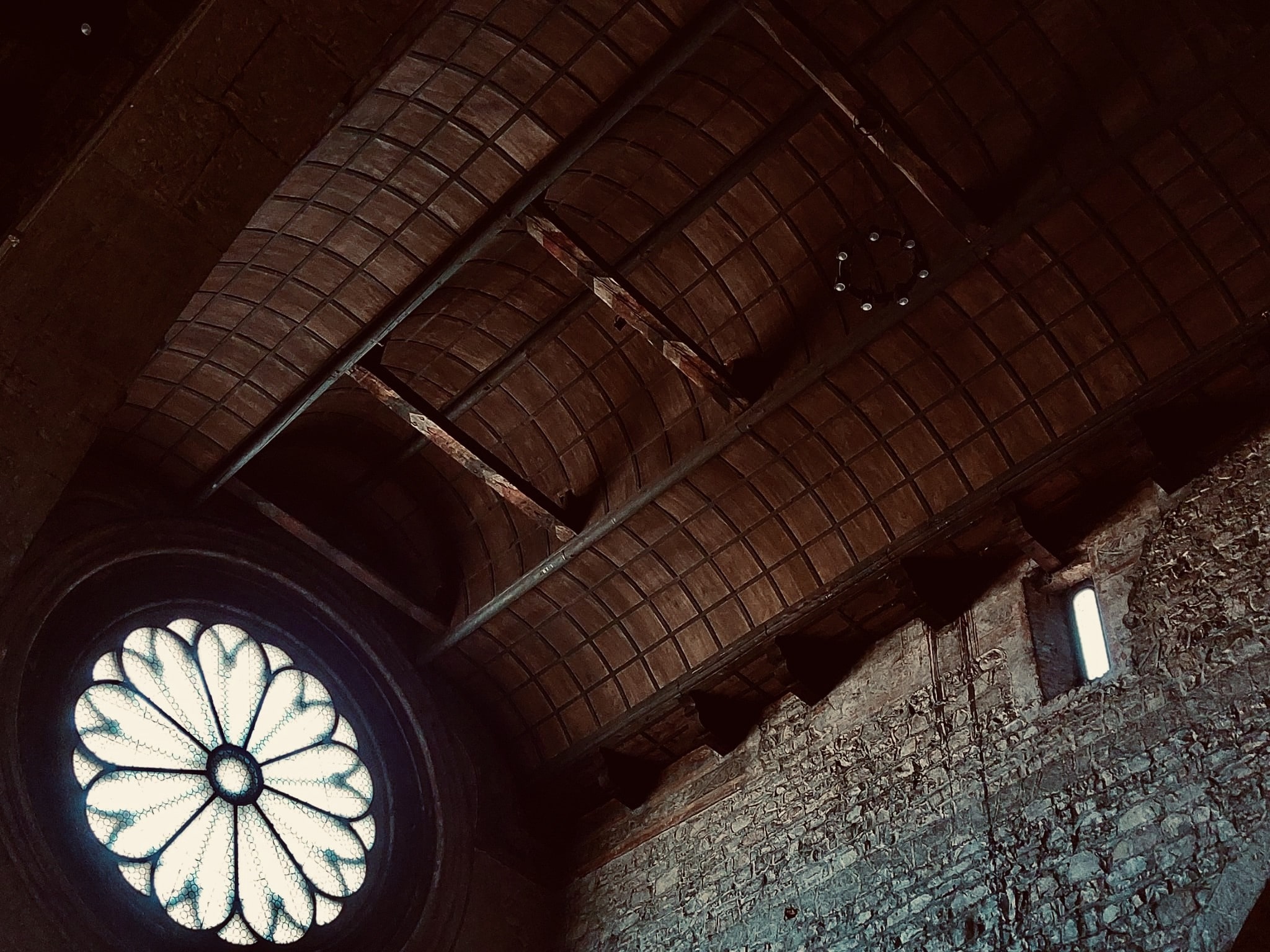
The interior of the church is striking for its simplicity and severity. The layout is the classic three-nave basilica, with the central nave characterized by a striking “ship’s keel” ceiling, while the lateral naves retain a simpler exposed beam ceiling.
The true splendor of the church, however, lies in its pictorial decoration, which is rich and of primary historical importance. On the right wall, there is a remarkable collection of votive frescoes. These paintings, which originally covered the entire surface and are mostly dated between the 14th and 15th centuries, include works of great interest, such as a Deposition in the Giottesque style and the fascinating scene depicting Friars and Seculars.
Along this wall, there are several precious altars, each adorned with important altarpieces. Among these, on the first altar, stands the panel by Moretto depicting St. Margaret of Cortona between Saints Francis and Jerome from 1530. Above the lunette, one can admire the fresco of the Visitation, recently attributed to Francesco Prata from Caravaggio. Also of great impact is the fresco of the Pentecost created by Romanino in 1520 and placed on the fourth altar. The presbytery, whose apse was enlarged by Antonio Zurlengo in the second half of the 15th century, houses other notable works: the canvas Virgin Enthroned with Child and Saints, one of Romanino’s early masterpieces (circa 1515), framed in an exquisite frame made by Stefano Lamberti; the altar frontal in marble, attributed to Antonio della Porta, known as Tamagnino; and the magnificent 15th-century wooden choir, composed of 22 stalls inlaid by Filippo Morari from Soresina.
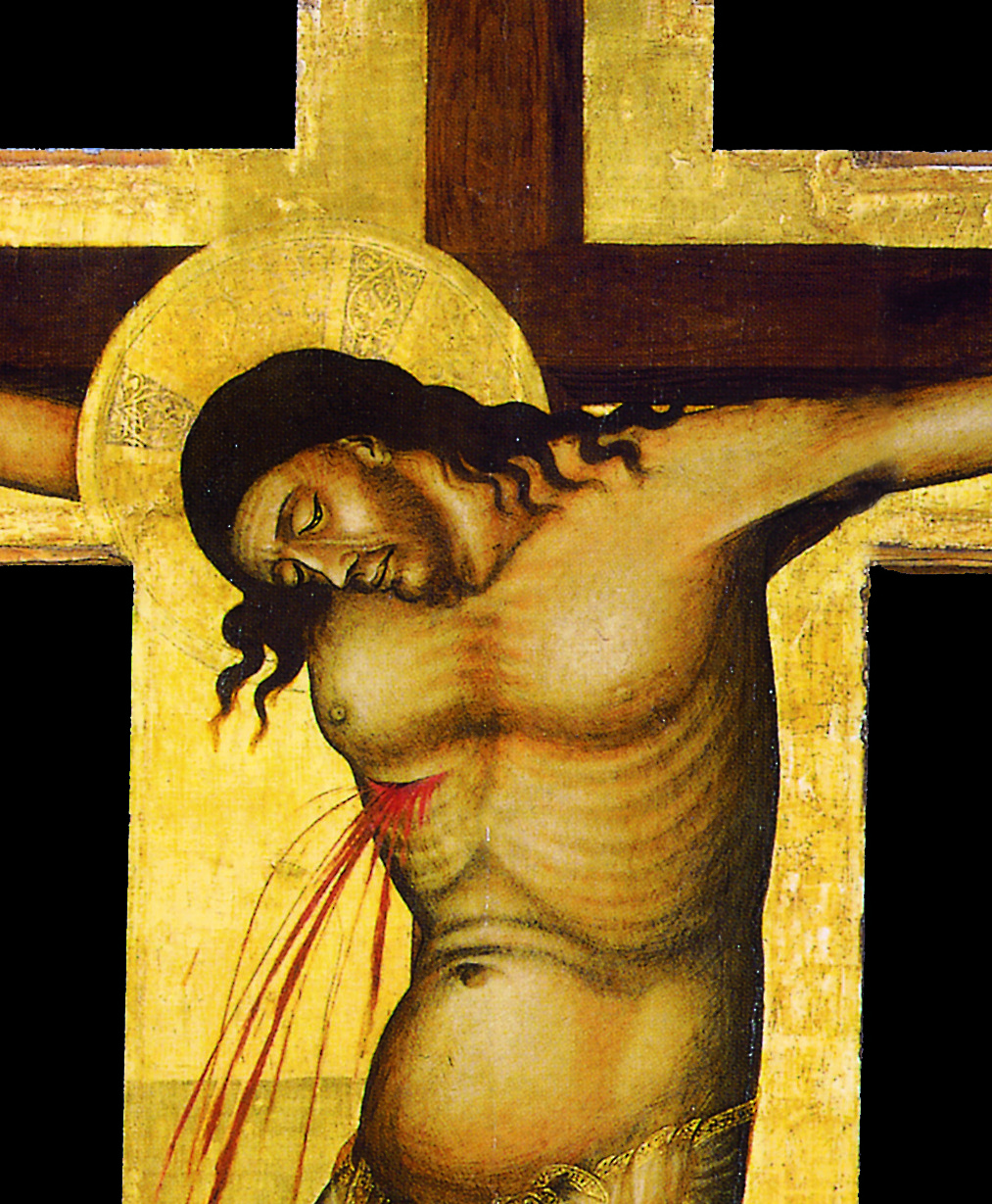
Finally, in the chapels opening in the left nave (added in the 15th century), the second chapel features a fine Crocefisso of Lombard school from the 14th century. The genius of Romanino is also behind the frescoes that decorate the five vaults of the apse.
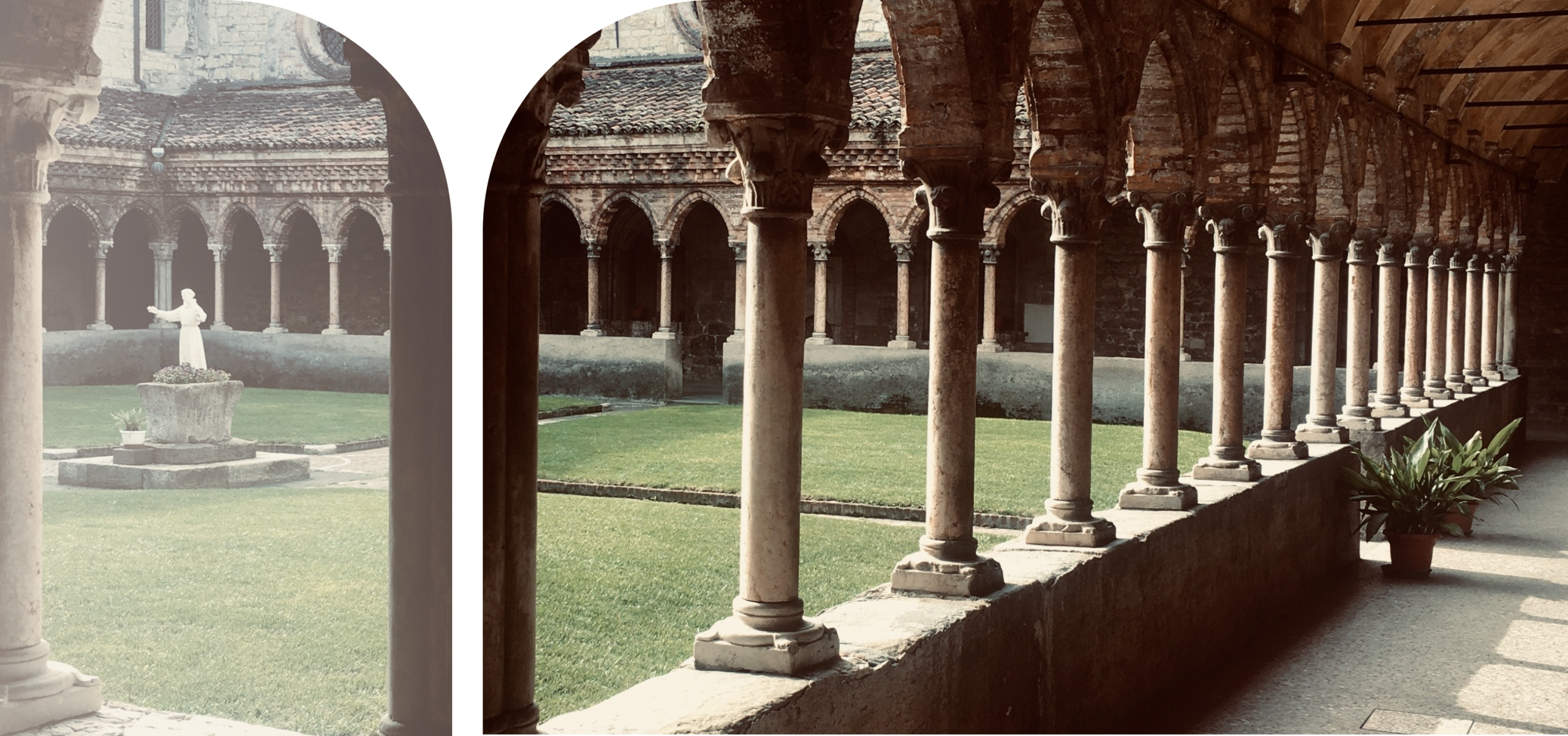
The St. Francis Complex is not only famous for its church but also for its two magnificent cloisters, authentic architectural gems often unknown to many. On the western side stands the unexpected and surprising Chiostro Grande. Built in 1394 by Guglielmo Frisone from Campione, this space is characterized by delicate columns in red Verona marble supporting elegant brick arcades. The access to this masterpiece is located halfway down the right nave of the church. From the rear door of the same nave, one enters the elegant Chiostrino dell’Immacolata, dating from the 15th century.
Also unmissable is the Renaissance Sacristy. Here are preserved the fine counters with inlaid backs by Filippo Morari from Soresina in 1511. The room also houses a treasure of goldsmith work: a large processional cross in repoussé silver and enamels from 1501, a precious work by Giovanni Francesco delle Croci, commissioned by the will of the Brescia friar Francesco Sanson, General Minister of the Franciscan Order.
The Franciscan Presence Today: Legacy and Mission
Today, the Franciscan community inhabits this place with the awareness of being the custodians of a centuries-old spiritual and cultural heritage. Our presence is deeply rooted in Brescia and is manifested daily in the life of the church, ensuring a stable presence of friar confessors; the activities of the community are varied and range from welcoming and spiritually guiding the faithful to the formation of various conventual groups. A central element of local devotion is the dissemination of the figure of Venerable Fra Giacomo Bulgaro (1879-1967), a humble porter friar known for his kindness and dedication to the poor, whose remains rest in a chapel of the church.
For all these reasons, the St. Francis complex has always been a recognized human and spiritual reference in the city and for the entire Diocese, a place loved and revered by all the Brescians.