ABOUT US

“Franciscans for Culture” is the portal of the Italian Province of St. Anthony of Padova of the Conventual Franciscan Friars, which tells the story of the places, historical and artistic heritage, and cultural initiatives that it preserves and promotes. Discover with us a history rich in art and sanctity.

The Italian Province of St. Anthony of Padova of the Conventual Franciscan Friars is a recent entity (2013) born from the union of the ancient “Patavina Province of St. Anthony” and “Bolognese Province of St. Anthony,” with roots tracing back to the Province established by St. Francis of Assisi in 1217, of which this is a new reorganization.

Geographically, the Province is based in Padova and extends across Piedmont, Liguria, Lombardy, Triveneto, and Emilia-Romagna, with a presence also in Portugal, Chile, France-Belgium, and Ghana. St. Anthony himself was Provincial Minister of these lands between 1227 and 1230.
Our history is a deep and fascinating journey: let’s retrace it together.

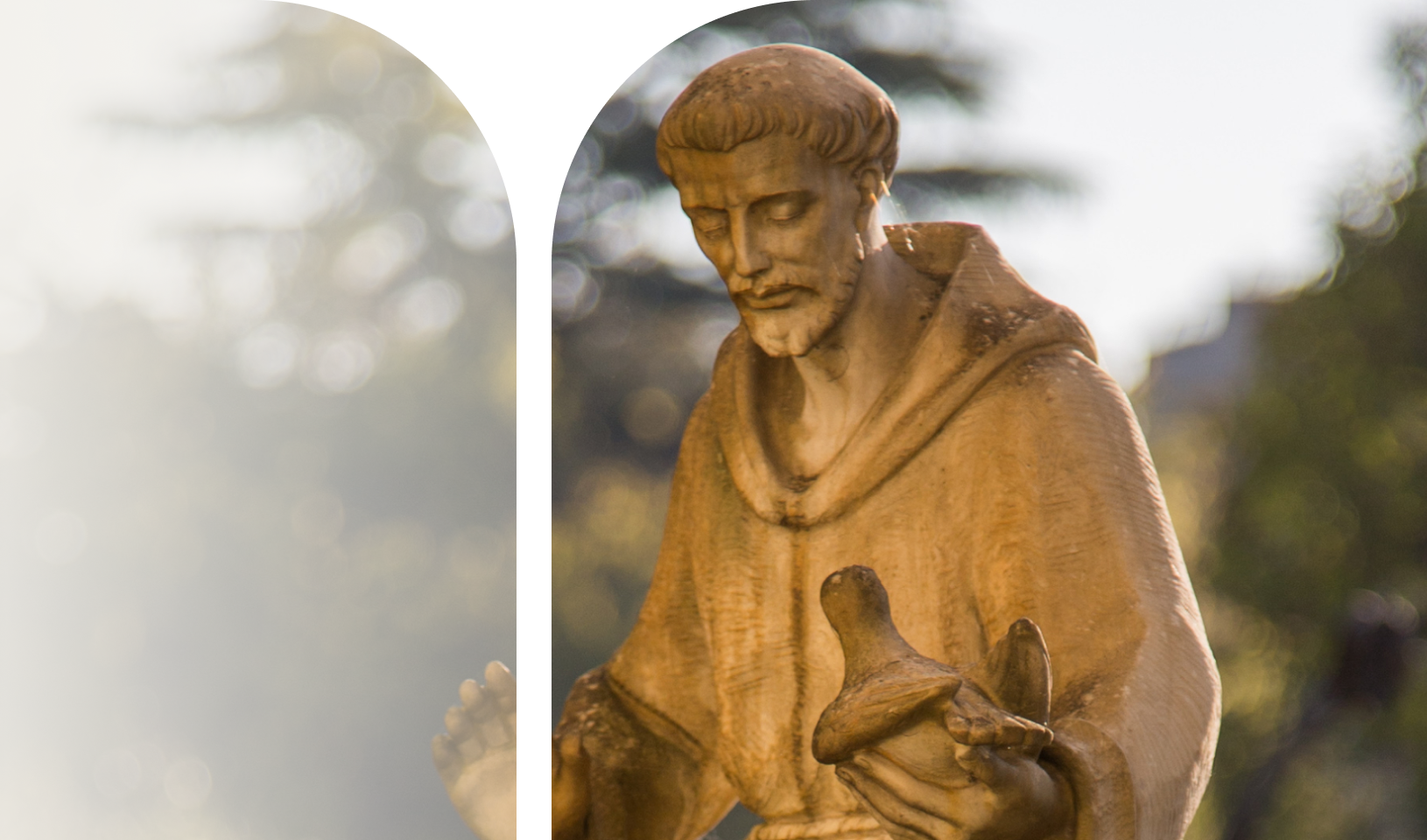
Our community of Conventual Franciscan Friars begins with St. Francis of Assisi (1181/1182-1226), the son of a wealthy merchant, who chooses a life of poverty and service to the most needy. With a group of companions, he spreads his message inspired by the Gospel. The Franciscan way of life attracts many from the very beginning, and in 1223, Pope Honorius III officially approves the Rule of Life of the Order, recognizing the fraternity within the Church.

The death of St. Francis in 1226, his rapid canonization in 1228, and the growth of the Franciscan Order led to a debate, both within the Church and within the Order itself, on the theme of poverty and, more generally, on the principles that should distinguish the friars.

The experience of St. Francis gave rise to a complex and evolving religious movement. From this movement, three orders were formed: the Friars Minor (male, divided into three families: the Minors, who since 1897 have united the various reforms that had developed, the Conventuals, and the Capuchins), the Poor Clares (female, founded by St. Clare), and the Secular Franciscan Order (laypeople living according to the Franciscan principles). The history of this movement is rich in transformations, divisions, and new unions.

Almost eight hundred years after the beginning of the Franciscan experience, the Order has expanded globally, organizing itself into territorial entities called “Provinces.” The Northern Italy Province is dedicated to St. Anthony of Padova.

Anthony of Padova, born Fernando in Lisbon in 1195, after initial formation among the Augustinian canons, entered the Franciscan Order in 1220, changing his name to Anthony.

He distinguished himself as a preacher and theologian of great culture, traveling through northern Italy and southern France to combat heresies and promote the faith. He taught theology in Bologna and became the Provincial Minister of Northern Italy from 1227 to 1230.

Although he stayed briefly in Padova, he formed a very strong bond with the city. He died at the age of 36 on June 13, 1231, at the gates of Padova and was buried in the basilica dedicated to him in the city. His reputation as a miracle worker led to his rapid canonization in 1232. In 1946, he was proclaimed “Doctor of the Universal Church” with the title of “Doctor Evangelicus.”